
Common questions. Straight answers.
Everything you need to know about HALO FastHub, from how it works to what procurement always asks
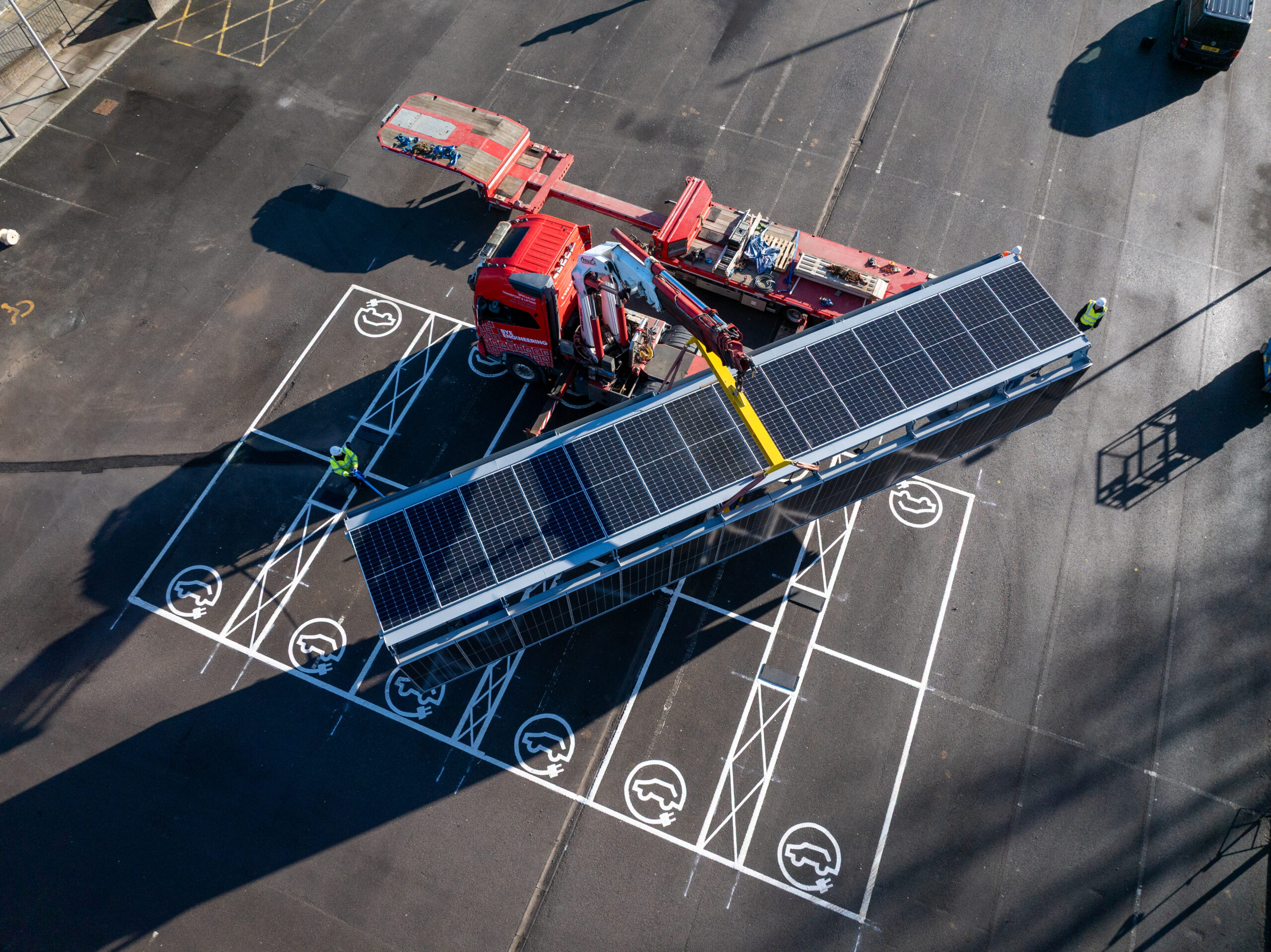
The HALO FastHub
What is HALO FastHub?
HALO FastHub is a smart solar EV charging hub — a single prefabricated unit that combines a solar canopy, battery storage, mains integration and 12 charge points. It is delivered to your site, crane-lifted into position and commissioned in a single day.
How many charge points does it have?
12 Type 2 AC charge points per hub, each capable of charging at up to 22 kW. Actual charge rate depends on the vehicle’s onboard charger capability and the total system load at the time.
What charge rates does it support?
Single phase: 3.6 kW or 7 kW. Three phase: 11 kW or 22 kW. The hub supports all combinations simultaneously, managed automatically by HALO.
What is HALO?
HALO is 3ti’s proprietary energy management platform — the operating intelligence behind every hub. It coordinates solar generation, battery storage and mains supply in real time, manages every charge point, handles payments and back-office administration, and exports data for ESG reporting. It runs continuously, 24/7.
Does it include CCTV and lighting?
Yes. Remote-access CCTV and sensor-controlled lighting are included as standard on every installation. Both are monitored 24/7.
What payment methods are supported?
Contactless, RFID card, app-based and account-free payments are all supported. Open access — no registration required — is available as an option. Operators set their own tariffs for different user groups.
What does the ongoing service include?
24/7 driver support, remote monitoring via HALO, planned preventative maintenance and an annual inspection are all included as standard. One number to call for everything.
Grid and power
Do we need a grid upgrade?
HALO FastHub works within your existing grid capacity. Dynamic Load Management (DLM) distributes load intelligently across all 12 charge points in real time, so the hub never draws more than your connection allows. We have deployed 21+ hubs without a single grid upgrade.
What is Dynamic Load Management (DLM)?
DLM is the mechanism that allows 12 charge points to operate simultaneously within an existing grid connection. HALO monitors total electrical demand across all charge points in real time. When aggregate demand approaches the site’s available capacity, HALO reduces charge rates dynamically to stay within the limit. As demand drops, available capacity is redistributed automatically.
How much grid capacity do we need?
HALO FastHub operates with a 230/400V TP&N supply at 100–250A. In most cases your existing connection is sufficient. We confirm the position at your free site survey.
What happens if the grid supply is interrupted?
HALO switches automatically to battery storage and continues managing charge points within available capacity. If battery storage is also exhausted, charging pauses safely and resumes automatically when supply is restored.
How does the solar generation work?
19.32 kWp of monocrystalline solar PV is mounted on the canopy above the parking bays, generating an estimated 18 MWh per year in a central UK location. HALO prioritises solar generation for charging, routes surplus to battery storage and draws from mains only when solar and battery cannot meet demand.
What is the battery storage capacity?
Up to 250 kWh, with a maximum output of 125 kW. The battery captures surplus solar generation and holds it for peak charging periods, overnight fleet charging or grid peak avoidance. Standard on all HALO FastHub installations.
Does HALO FastHub support bidirectional charging (V2X)?
Yes. HALO FastHub supports Vehicle-to-Grid (V2G) and Vehicle-to-Everything (V2X) charging, enabling compatible EVs to return energy to the building, the battery or the grid. V2X requires a vehicle that supports CHAdeMO or CCS Combo 2 bidirectional protocols. Compatibility is confirmed at survey stage.
Planning and permissions
Do we need planning permission?
In most cases, no. The position varies slightly by country:
England
HALO FastHub typically qualifies as permitted development, provided it meets the standard criteria: no more than 4m in height, no less than 10m from the boundary of a dwellinghouse, not in a Conservation Area or the curtilage of a listed building, and sited on land authorised for use as a non-residential car park.
Scotland
HALO FastHub is permitted development under Scottish planning legislation. No prior approval or planning application is required. We can secure a formal Certificate of Lawfulness confirming this position if required.
Wales
Planning permission is required in Wales due to different legislation. The process mirrors the England prior approval criteria but results in a full planning permission. The approval process typically takes 56 days. We manage the application end-to-end.
What is prior approval?
Prior approval is a simplified planning process in England. Permission is granted if the installation meets defined criteria — principally maximum height of 4m, not within the curtilage of a listed building, and no unacceptable impact on a Conservation Area or National Park. The process considers siting, design and appearance only.
What if our site is in a Conservation Area or near a listed building?
We manage the planning application on your behalf at no additional cost. Our team has experience navigating sensitive planning environments. We confirm the specific requirements for your site at survey stage.
Connectivity
What internet connection does HALO FastHub need?
A basic wired LAN/WAN connection with an RJ45 Ethernet port. Minimum bandwidth of 1–2 Mbps, with typical data usage of 5–30 GB per month. No inbound routing is required; outbound ports must remain open.
What if our site has poor connectivity?
HALO FastHub uses dual-channel fail-over communications. The primary channel is a client-hosted wired LAN/WAN. The built-in 4G/5G cellular modem acts as automatic back-up if the primary connection is interrupted. HALO continues to operate during any connectivity interruption.
What connectivity options are available?
- Client-hosted LAN/WAN (preferred) — most reliable and cost-effective.
- Wi-Fi with SIM back-up — suitable where a strong signal is available.
- Starlink with SIM back-up — for remote locations.
- Dedicated business broadband with SIM back-up.
SIM-only is not recommended as a primary connection. It is suitable for short-term use only.
Is the system secure?
Yes. HALO FastHub is Cyber Essentials certified. All communications are encrypted using SSL and VPN. Systems use managed firewalls and secure subnets. Software is updated regularly with security patches applied remotely.
Back-office integration
Can HALO FastHub integrate with our own charge point management system?
Yes. Two integration options are available for customers with existing back-office systems.
Option 1 — Direct integration
HALO FastHub’s charge points communicate directly with your back-office system. This is the simpler connection but disables HALO’s advanced features — remote fault monitoring, smart energy management and local DLM. Best suited to sites with robust internal systems and no grid capacity constraints.
Option 2 — Indirect integration (recommended)
HALO FastHub connects to HALO first, which then interfaces with your back-office system. This retains the full benefits of HALO — remote monitoring, fault resolution, advanced DLM and energy management — while your back-office handles user authentication and payment management.
This option is recommended for any site with grid capacity constraints or where monitoring, reporting and energy management are important.
What protocols does HALO FastHub use?
OCPP 1.6 and OCPP 2.0.1. Both are supported. Your integration option is confirmed at survey stage
What procurement always asks
The questions that come up on every procurement review, every board paper and every due diligence process. Answered directly.
Do we need planning permission?
In most cases, no. HALO FastHub qualifies as permitted development in England and Scotland. Wales requires a full planning permission, which we manage end-to-end. We confirm the specific position for your site at survey stage.
Is a grid upgrade required?
No. HALO FastHub works within your existing grid capacity. Dynamic Load Management means the hub never draws more than your connection allows. 21+ installations. Not one grid upgrade.
Who owns the hardware?
On a CapEx purchase, you own the hardware outright from day one.
On a lease, 3ti Energy Hubs retains ownership throughout the term. At end of term you can renew, upgrade to the latest specification, or we decommission and remove the installation at no cost.
What happens at end of lease term?
Three options. Renew on current or updated terms. Upgrade to the latest hub specification. Or we remove the installation and reinstate the site at no cost to you. We present the options before the end of term without pressure.
What accreditations and certifications does HALO FastHub hold?
- ChargeSafe accredited
- PAS 1899:2022 compliant
- Cyber Essentials certified
- ISO 9001 ISO 45001
- EVies Award winner
- British Parking Awards — Best Product in New Technology
- E-Mobility Award winner 2023
- 3ti Energy Hubs is a certified B Corporation
How is solar and energy performance measured and reported?
HALO logs generation and consumption at half-hourly intervals. Monthly reports cover solar generation, battery throughput, grid draw, charge sessions and carbon savings. Data is exportable to CSV and compatible with ESOS, SECR, SBTi and BEIS reporting formats. API integration with fleet management systems is available.
What is the warranty?
Three years as standard. A five-year extended warranty is available. All hardware is covered. Ongoing O&M, remote monitoring and driver support are included in the service agreement from day one.
What is the minimum site size?
HALO FastHub requires approximately 14 parking spaces to accommodate the canopy footprint and accessible charging bays. The recommended area is 18.22m × 10.10m. We confirm suitability at your free site survey.
How long does installation take?
One day. A single HIAB crane lift places the prefabricated hub. Our team connects to your existing distribution board. HALO is pre-loaded, tested and commissioned. Handover and operator training completed the same day.
Can multiple hubs be installed on the same site?
Yes. Multiple HALO FastHub units can be installed on the same site and daisy-chained to share a single connection point. The Northern Care Alliance installation at Salford Royal used two units delivering 24 charge points, installed in three days.
Still have a question?
We are happy to help. Call us, send an email or book a call and we will answer anything the FAQ hasn’t covered.
+44 (0)3332 343 703